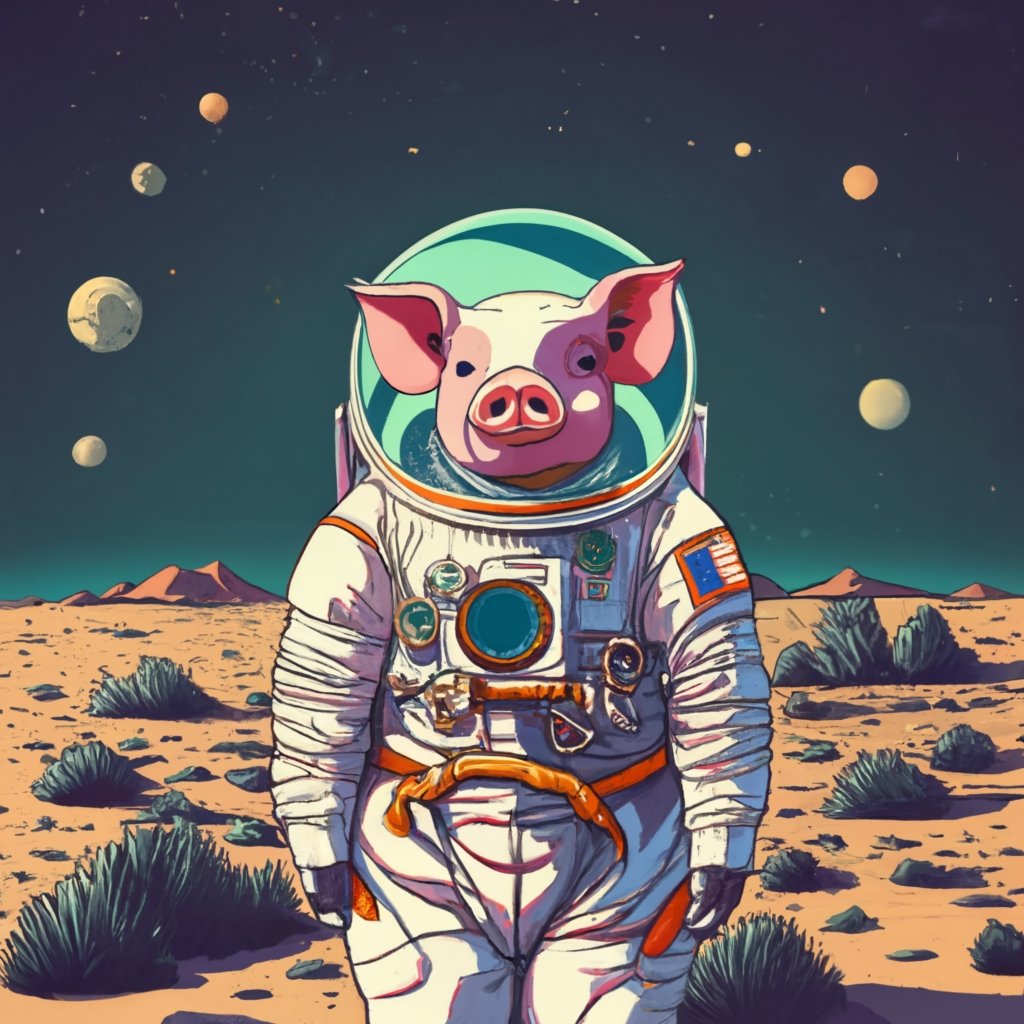
In a galaxy far, far away, a humanoid space pig named Porkr was the star coder for NebulaTech, a tech giant on Planet Hogwash. Porkr wasn’t your average pig—besides his dexterous hooves and love for programming, he had a secret. Encrypted within his DNA were the quantum keys capable of unlocking the cosmic firewall. You see, legend had it that the entire galaxy was a simulated construct, and those keys could access the underlying code.
Porkr didn’t buy into folklore, but he was obsessed with quantum computing. He was convinced that the computational power could solve the ultimate optimization problem—how to evenly distribute galactic resources, resolving an interstellar war that had lasted eons.
One night, while deep-diving into a matrix decomposition of a gargantuan dataset, Porkr noticed a pattern. A repeating fractal embedded in the cosmic data, a sort of Easter Egg hidden by the universe itself. “If the universe is showing its work, why shouldn’t I?” he thought.
Just think of the universe as an infinitely complex system, not unlike a neural network. Imagine each star as a neuron, firing signals like solar flares. Porkr decided to employ eigenvectors to collapse this multidimensional problem into a manageable form.
Porkr developed an algorithm—a quantum eigenvector centrality computation, if you will—that used his DNA as the quantum keys. He ran it through NebulaTech’s quantum computer, unsure of what might happen.
As the computation ended, Porkr snorted. The quantum computer blinked and spat out a holographic projection, revealing the optimal distribution of galactic resources. Simultaneously, the cosmic firewall was unlocked, confirming the galactic simulation theory.
Unaware of the firewall but ecstatic about his findings, Porkr broadcasted the solution galaxy-wide. The war ceased. Factions that had been enemies for millennia began sharing resources, amazed by the sudden balance.
However, Porkr’ quantum keys also did something else—they upgraded the universe’s source code. His algorithm hadn’t just ended the war; it had triggered a galactic update, an optimized version of reality itself.
No one noticed the subtle changes, like the twinkling of stars resembling patterns in prime numbers, or black holes that started emitting low-frequency oinks.
Porkr, now a hero, decided not to reveal the cosmic simulation theory confirmation. “Let them have their victory,” he thought.
With a satisfied snort, he returned to his workstation. There were still countless datasets to explore, and who knows? Perhaps, somewhere in that cosmic data, lay another Easter Egg, a fractal, or a joke, hidden by the universe for the pigs—or beings—curious enough to find it.
***
Porkr quickly became the galaxy’s most celebrated data scientist. Offers to work on prestigious projects poured in from every corner of the universe. But Porkr was obsessed with something else—the idea that the universe had even deeper layers of code. With his newfound reputation and resources, he started Project Oinkfinity, aiming to unlock the universe’s hidden dimensions.
This wasn’t just dimensional analysis; Porkr was venturing into a realm that transcended conventional physics. Think of the universe as a high-dimensional tensor, a block of numerical values indexed in multiple ways. Now, what if those tensors could be decomposed into more manageable low-rank approximations? What kind of ‘approximations’ would exist in a universe that is already an optimized simulation?
“I’ve got to make this calculation extremely efficient,” Porkr thought. He dived into approximation algorithms, utilizing techniques like stochastic gradient descent coupled with quantum annealing to solve the complex optimization problem.
He added some reinforcement learning to the mix, allowing the algorithm to “learn” from each interaction with the universe’s fabric. Imagine this like tweaking the hyperparameters of your machine learning model but in a way that adjusts the fabric of reality itself.
When Porkr finally ran his updated quantum algorithm, the universe seemed to shiver. For a moment, every being, every object, every molecule felt an inexplicable joy, like a neural network suddenly converging after countless epochs.
The holographic projector flickered and displayed a new message: “Welcome to Universe 2.1: Now with extra dimensions and multiverse compatibility.”
Multiverse compatibility! Porkr couldn’t believe his eyes. His algorithm had unfolded additional layers of reality, revealing that their universe was just one in a series of interlinked simulations, like hyperlinked web pages in the cosmic internet.
Almost immediately, communication channels opened between multiple universes. As beings from different realities interacted, it was discovered that each universe had its own version of Porkr—a pig, a human, a sentient cloud of gas—all had played a role in upgrading their own slice of reality.
A multiverse council was formed, and Porkr became its inaugural chairpig. Now, facing an array of realities and even more complex datasets, he was in hog heaven.
Though the universe still held many secrets, one thing was certain: the answers lay in the code, and Porkr was just the pig to uncover them. With a cosmic snort that reverberated across multiverses, Porkr delved back into the data.
Because for Porkr, the quest for knowledge was never-ending, much like the recursive fractals he so loved. And somewhere, in some layer of universal computation, it felt as if the universe—or should we say, multiverses—gave a satisfied oink in return.
***
As chairpig of the Multiverse Council, Porkr was busier than ever. The council was working tirelessly to harmonize the physics, ethics, and resources among interconnected universes. But Porkr felt a nagging sensation, an intellectual itch that couldn’t be ignored.
Through all these upgrades and changes, one paradox remained: could a universe so complex be fully optimized? Could there exist a perfect function that maps every event, thought, and interaction in all realities to a single ‘optimal’ point?
Imagine if all existence was a vast optimization problem—like a multi-objective function in machine learning with not just two or three, but infinite variables to consider. Porkr imagined creating an autoencoder of existence itself. Input the messiness of infinite realities and output a compressed, optimized universal state.
“We need to implement a cosmic backpropagation algorithm,” he mused, “one that adapts itself based on the residual errors between the predicted and actual states of multiversal phenomena.”
Porkr assembled a team of the brightest minds (and snouts) from across the multiverse. Together, they developed a self-correcting, unsupervised learning model. Picture this as a generative adversarial network (GAN) where one network generates ‘ideal’ universe states, and another evaluates them, but at a cosmic scale.
After what felt like eternities of computational time, they were ready to deploy the Cosmic Backpropagation Algorithm, abbreviated affectionately as CoBA. When the algorithm was activated, every atom in the multiverse shuddered.
Instead of a message or hologram, Porkr felt a profound sense of interconnectedness. Suddenly, he understood the paradox. A fully optimized universe would allow for no variance, no unpredictability, no freedom. It would be a static, lifeless construct, like a neural network overfitted to its training data. The fluctuations, the imperfections, and even the conflicts were not bugs but features—essential elements that fueled growth, learning, and existence itself.
The algorithm did make one alteration, however. It added a constant, an unchangeable value in the equations governing the physics of the multiverse. Scientists across realities would later call this “Porkr’ Constant,” baffled by its sudden appearance and its value that seemed to encode a simple message: “Optimization is a journey, not a destination.”
Porkr, with his newfound wisdom, disbanded the Multiverse Council. It was replaced by a decentralized network of nodes responsible for managing localized challenges while considering their global impact. Each node operated based on principles set forth by CoBA, creating a robust and resilient framework for multiversal governance.
Retiring from his public roles, Porkr returned to his original passion—data analysis, pondering smaller-scale but still perplexing questions, like “What is the optimal way to distribute treats among a family of piglets?”
As he delved into the dataset, crunching numbers and plotting variables, Porkr couldn’t shake off a comforting thought: the multiverse was not meant to be solved entirely; it was meant to be lived, experienced, and ever-so-gently optimized.
With that understanding, Porkr let out a soft, satisfied oink—a tiny fluctuation in the grand scheme of things, yet a moment that felt perfectly optimal.

 Ishti.org